

There is a moment in every new relationship where your history knocks. Maybe they ask about your family and there is a person missing from your answer. Maybe a song comes on. Maybe it is just a Tuesday and the grief picks Tuesday.
And you do the maths every griever knows: is it too early to bring this up? Too heavy? Will I become “the sad one” before I have finished being “the fun one”?
Why does sharing loss feel so risky in new relationships?
Because new relationships run on lightness, and grief feels like the opposite of the brand. So people hide entire chapters of themselves through the exact months when two people are supposed to be learning each other, and the relationship grows around a locked room.
Here is what that maths misses: the loss is not baggage to disclose. It is load-bearing. It shaped how you love, what you fear, what you refuse to take for granted. Hiding it does not protect the relationship. It just keeps the relationship shallow on purpose.
Grief is not the fine print of your story. For most of us, it is a main chapter.
Losing Dad is part of my story, and anyone who was going to matter needed to meet that part eventually. The kind ones always made space. That told me everything I needed to know.Ness, founder of Good Chat
How do you actually bring it up?
- Say it plainly, in daylight. “I want you to know about someone important to me. My dad died a few years ago, and he is a big part of who I am.” Calm delivery teaches them the topic is speakable.
- Give them a way in. They will be scared of getting it wrong. Hand them the manual: “You do not have to say anything perfect. I just like being able to mention him.”
- Share the person, not just the loss. Tell the funny story. Show the photo. Let them meet who you lost, not just the fact of losing. You are introducing someone, not confessing something.
You are introducing someone you love, not confessing something you did.
What does the right response look like?
Simple, mostly. They ask a question instead of changing the subject. They remember the birthday, the anniversary, the name. Weeks later they say “your dad would have loved this” unprompted, and you realise the locked room has a window now.
And if someone flinches, minimises, or treats your grief like an inconvenience? That is not embarrassing information about you. That is early, useful information about them.
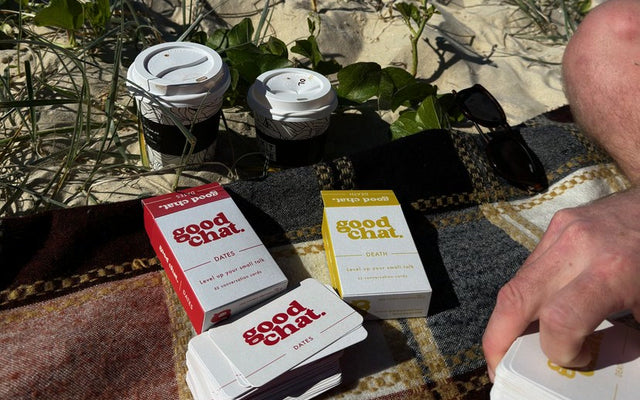
I expected this to feel heavy. It is intense but also incredibly gentle. The questions do not push you further than you are ready to go.Stuart, in a five-star review of the Death deck
You do not owe anyone your grief on a schedule. But the people worth keeping can hold it, and the only way to find out is to let them try. The realest part of you deserves to be met, not managed.